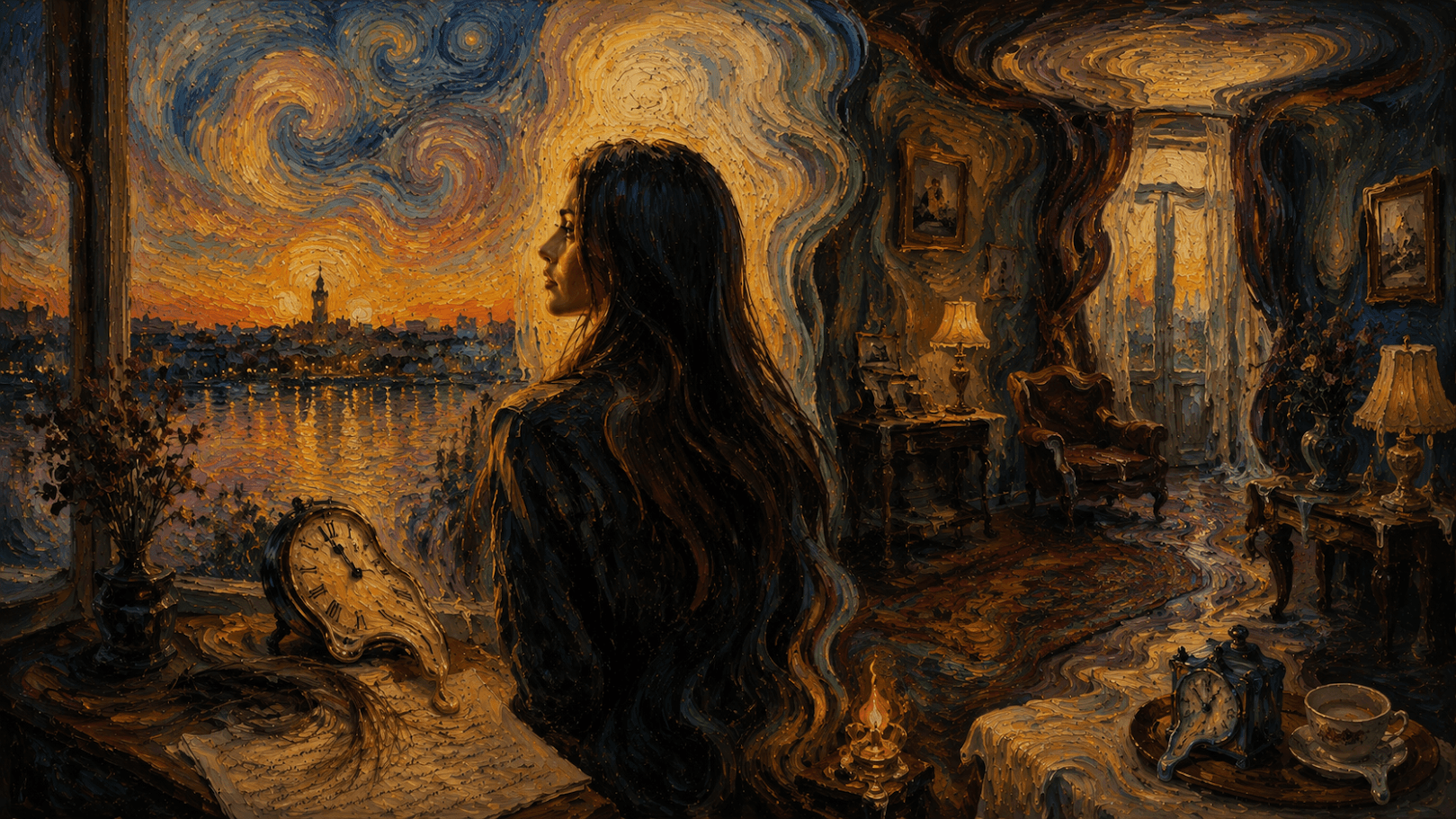
There are some people you feel yourself getting closer to without really knowing why. Children do this best. They haven’t learned shame yet, so they haven’t learned to betray their instincts. They feel warmth, and they go. Simple. True. Growing up usually means moving away from that kind of knowing. But around certain people, that distance disappears without you noticing. You feel something you can’t explain, something you can’t put into words. But your body knows it is real. These are often people who understand others better than they understand themselves.
Fathers sometimes build a home with a sentence. Sometimes a wall. Without realizing it. Sometimes even with love. A ranking gets created — who comes first, who comes after, who matters a little less. It gets said once and left there. The sentence ends. But the person doesn’t. They carry it with them. It feeds something inside them. Years pass, and that old ranking stops being just a memory. It becomes gravity. A person falls according to it. Stands according to it. Doubts themselves according to it. And yet she was the one holding life together. Holding everyone together. The one people looked for first. The one with the highest emotional intelligence. The one who handled things best. The strongest in the most visible ways. But none of that counted, because there was no language in that house for things like that. Some qualities only become visible during a crisis. Once the crisis passes, they are forgotten. And the person carrying those qualities gets so used to being invisible that even when they want to be seen, they no longer know how.
She doesn’t like her hair. Maybe her hair doesn’t like her either. It has thinned out. Gone quiet. When your natural self is not accepted, you eventually start rejecting it too. You look in the mirror and see an enemy. But the enemy is not in the mirror. It is much older than that. There are many people who straighten what curls, hide their natural color, try to change what they were given. Fighting a part of your own body every day is exhausting. And once it becomes a habit, it no longer feels like a fight. It feels like a routine. Normal. Inevitable. As if it has always been this way. But that hair was born wavy. Made to rise. Made to spread. Then someone looked at it and didn’t like it. Then someone else. Then the mirror. Then she did. It was flattened. Controlled. Not allowed to be itself for years. The more it was forced, the thinner it became. More fragile. But it never disappeared. Because some things, no matter how often they are rejected, refuse to stop existing. That is not weakness. Sometimes it simply means they never learned another way to exist. Not knowing how to leave can be a kind of loyalty. Or sometimes, it is the oldest and quietest relationship a person has with the thing that hurts them most.
Everyone takes something from her. As if she has six hundred years to give. As if her time never runs out. As if no one will ever have to stop and ask what is left. Some people do not end up where they are because of one big decision. They get there through years of small surrenders. One step. Then another. Then one day they look back and realize the road has already closed behind them. A small town. A narrow life. But the narrowness is not the town. The town only reflects what already exists inside. Even there, children love her. Even there, the phone rings and she answers. Even there, everyone comes before her. The place changes. She doesn’t. Because wherever people go, they carry what they carry.
She is the first person people call on bad nights. And on good mornings too. The phone rings, and she answers. The hour doesn’t matter. The subject doesn’t matter. Her exhaustion doesn’t matter. Because not noticing herself is one of her oldest habits. Making herself invisible too. Even someone else’s ordinary problem gets her full attention, as if everything depends on it. Her neck hurts. She needs to go to the bathroom. Her stomach is empty. Her body keeps asking for something. She ignores all of it. Because in that moment, the other person feels more real than she does. This is not humility. This is what happens when you put yourself second for so long that first place starts to feel strange. Everyone tells her things. Not just secrets. Shame. Ugly thoughts. Things they have never told anyone. They come in completely exposed, without hesitation. She is like a furnished house with no one living inside. There are no mirrors in that house. No echo. Not because of the walls, but because years of silence absorb everything. No one hears their own voice coming back. They can become whoever they want in that space. No one corrects them. Nothing reflects them back. That is why they talk. That is why they are not afraid. Because where there is no mirror, there is no judgment. And in a place without mirrors, people always look beautiful to themselves.
Maybe she chose to stay at the edge of life. Not because she wanted to avoid living. Because she wanted to listen. People who are waiting for their turn to speak cannot really listen. They get impatient. They prepare their next sentence while the other person is still talking. But she always listened. Fully. Without interruption. And there is a cost to that. Giving up your own story. A life never lived. Never spoken. Never given its turn. A life filled with other people’s lives instead of her own. Life can pass without ever being lived. At some point, she learned that. And the strangest part is that it may not even feel like loss. Because to lose something, you must have had it first. And grieving something you never had is a kind of pain language doesn’t know how to hold. Silent. Nameless. Without history. Impossible to explain. Because to explain it, it would have needed to be lived first.
One morning she wakes up, like always. Steps onto the scale, like always. The number has changed. In the direction she wanted. She stands there, feet on the cold floor. Waiting. For something inside her to open. For relief. For satisfaction. For some kind of happiness. Nothing comes. She should be happy. She knows that. But happiness is something people learn too. A person first learns whose eyes they are supposed to see themselves through. Then they learn how to look. And that morning, she stands there staring at the number. The number is right. Everything is right. Inside, there is nothing.
For some people, time does not move the way it does for everyone else. Their clock is not made of calendar pages. It is made of the people around them. Someone gets engaged, and something quietly tightens inside her. She smiles. Congratulates them. Maybe she is genuinely happy. But somewhere deep down, something keeps count. Writes someone else’s date into her own private memory. Being late is not always about failing to arrive somewhere. Sometimes it means living inside other people’s timelines. When you do not have your own clock, you keep checking everyone else’s. And when you do that, the hands always seem to point to the same place. A little behind. Years pass. The hands do not move. Because that clock was never really set. It was handed over too early. Too gently. Placed in someone else’s hands. And those hands set it according to their own time. With love. Without ever meaning to. And the question remains: Whose clock has this been all these years?
Maybe that is why some loves stay platonic. Untouched. Always at a distance. Because real love asks for something real. It says: I am here. See me. And being truly seen can be terrifying for someone who has spent their whole life feeling small. Loving from a distance feels safer. Burning quietly. Staying warm without getting close to the fire. Living forever at the doorway. Neither inside nor outside. Neither yes nor no. Because the person standing at the doorway cannot be rejected. But the person loved from afar never arrives. They can’t. Because they were never invited in. And eventually, the uninvited knock on another door. That is inevitable. That always happens. Only the timing is unknown. And that uncertainty is the heaviest part of platonic love. Knowing they will not come. Still hoping they will. Sitting by the door. Never knocking.
Shame is different from guilt. Guilt says: I did something wrong. Shame says: There is something wrong with me. The difference looks small. It isn’t. Guilt points to an action. Then passes. Shame points to the person. And stays. Someone carrying that kind of shame starts to feel undeserving of everything. Love. Attention. Space. So they place themselves at the bottom of every list. Because putting themselves first feels like stealing. And stealing would only prove what they already believe. The cycle closes. Inside a closed cycle, everything makes sense. Shrinking. Staying quiet. Taking less. It all feels natural. But it is not. It is a decision made long ago and never questioned.
There are some people you never need a reason to be close to. You call them. Or they call you. You talk. And when the conversation ends, something inside feels lighter. You do not know exactly when it happened. Or how. It just did. These people are not always the best with words. They do not always say the perfect thing. But they know how to be there when it matters. And that is much rarer. They love completely. No half-love. If something enters their world — a person, an idea, a sound — it enters fully. That is why being loved by them feels different. Not casual. Not temporary. It has weight. It stays. When someone like that loves you, you feel as though you belong somewhere. Even if you cannot explain why. Even if you cannot prove it. You simply know.
And maybe this is the heaviest truth of all: The people who give the most are remembered the least. But maybe names are not always necessary. Some people leave marks without ever being properly named. The places they pass through feel different afterward. The people they leave behind grow differently. That kind of change is invisible. But invisible does not mean unreal. It only means no one looked closely enough.
Writing is my way of understanding myself and the world. Through essays and reflections, I explore identity, language, and transformation — the small moments that shape who we are.
Stay connected — subscribe to my newsletter for new pieces and thoughts on writing and life.